
When human skeletal remains are recovered in a shallow grave, a dense forest, or an abandoned building with no wallet, no fingerprints, and no hits in national DNA databases, forensic anthropologists turn to an invisible atomic ledger written into human tissues: stable isotope ratio analysis (SIRA).
The Principle of Geochemical Provenance: The Atomic Record
Every living organism is an open thermodynamic system exchanging matter with its local environment. The water we drink, the vegetables and livestock we consume, and the air we breathe carry distinct ratios of heavy-to-light atomic isotopes determined by regional geology, atmospheric physics, and rainfall chemistry.
Unlike unstable radioactive isotopes such as Carbon-14, which decay exponentially over millennia, stable isotopes do not decay. Their relative abundance in environmental water and soil remains fixed over centuries. When ingested, these elemental isotopes—specifically strontium, oxygen, hydrogen, lead, carbon, and nitrogen—are incorporated into the crystalline mineral lattice of human hydroxyapatite (bone and tooth enamel) and the organic protein matrix of keratin (hair and fingernails).
Isotope ratios are expressed using delta notation (δ) in parts per thousand (per mil, ‰) relative to international measurement standards:
δX (‰) = [ (R_sample - R_standard) / R_standard ] × 1000
where R represents the ratio of the rare heavy isotope to the abundant light isotope (for example, 18O/16O or 13C/12C).
The Core Elemental Systems in Forensic Anthropology
By combining multiple isotopic systems, forensic geochemists construct multidimensional geographic probability profiles, commonly known as isoscapes:
| Isotope System | Measured Substrate | Primary Source in Life | Forensic Intelligence Yield |
|---|---|---|---|
| Strontium (87Sr/86Sr) | Enamel & Cortical Bone | Local bedrock geology weathered into soils and groundwater | Identifies specific geological provinces, bedrock age, and childhood residence. |
| Oxygen (δ18O) / Hydrogen (δ2H) | Enamel Phosphate / Bone Hydroxyapatite | Consumed meteoric drinking water (precipitation cycle) | Reveals latitude, elevation, temperature, and continental inland distance. |
| Lead (206Pb/204Pb, 207Pb/204Pb) | Tooth Enamel Bioapatite | Industrial atmospheric pollution, gasoline emissions, local plumbing | Distinguishes international vs. North American environmental exposure. |
| Carbon (δ13C) & Nitrogen (δ15N) | Bone Collagen & Hair Keratin | Dietary intake: C3 vs. C4 plants, marine vs. terrestrial protein | Reconstructs socioeconomic diet, agricultural staples, and trophic position. |
1. Strontium Ratios (87Sr/86Sr): Reading the Bedrock
Strontium possesses four stable isotopes: 84Sr, 86Sr, 87Sr, and 88Sr. Radiogenic Strontium-87 is produced by the extremely slow radioactive β-decay of Rubidium-87 (87Rb), with a half-life of 48.8 billion years. Consequently, ancient granitic rocks, such as the Canadian Shield or the Appalachian crystalline core, exhibit significantly elevated 87Sr/86Sr ratios (>0.710 to 0.725). Conversely, geologically young volcanic rocks and marine carbonates—such as the limestone bedrock of the Florida platform or the Caribbean—yield distinctly low ratios (~0.707 to 0.709).
Because divalent strontium ions (Sr2+) share an ionic radius nearly identical to calcium (Ca2+), strontium readily substitutes for calcium within the hydroxyapatite crystalline lattice [Ca10(PO4)6(OH)2] of human teeth and bone without undergoing measurable biological fractionation. As a result, the strontium ratio preserved in human bioapatite directly mirrors the local bedrock geology where food and water were grown and consumed.
2. Oxygen Ratios (δ18O): The Hydrologic Evaporative Gradient
Oxygen isotopes trace the planetary hydrologic cycle through Rayleigh distillation. When water evaporates from warm tropical ocean waters, water molecules containing the lighter oxygen isotope (H216O) evaporate more readily than those containing the heavier isotope (H218O).
As moist air masses migrate inland and move toward higher latitudes or rise over mountain ranges, precipitation preferentially removes the heavier 18O molecules first. Consequently, precipitation becomes progressively depleted in 18O as one moves further inland, further north, or to higher elevations. Human drinking water directly reflects this spatial gradient: coastal Florida precipitation averages δ18O values between −2‰ and −4‰, while precipitation in Minnesota or the northern Rocky Mountains drops to between −12‰ and −18‰.
The Human Anatomical Timeline: Enamel vs. Bone vs. Hair
The true power of forensic SIRA lies in comparing different skeletal and keratinous tissues harvested from the same decedent, each of which records a distinct chronological window of life:
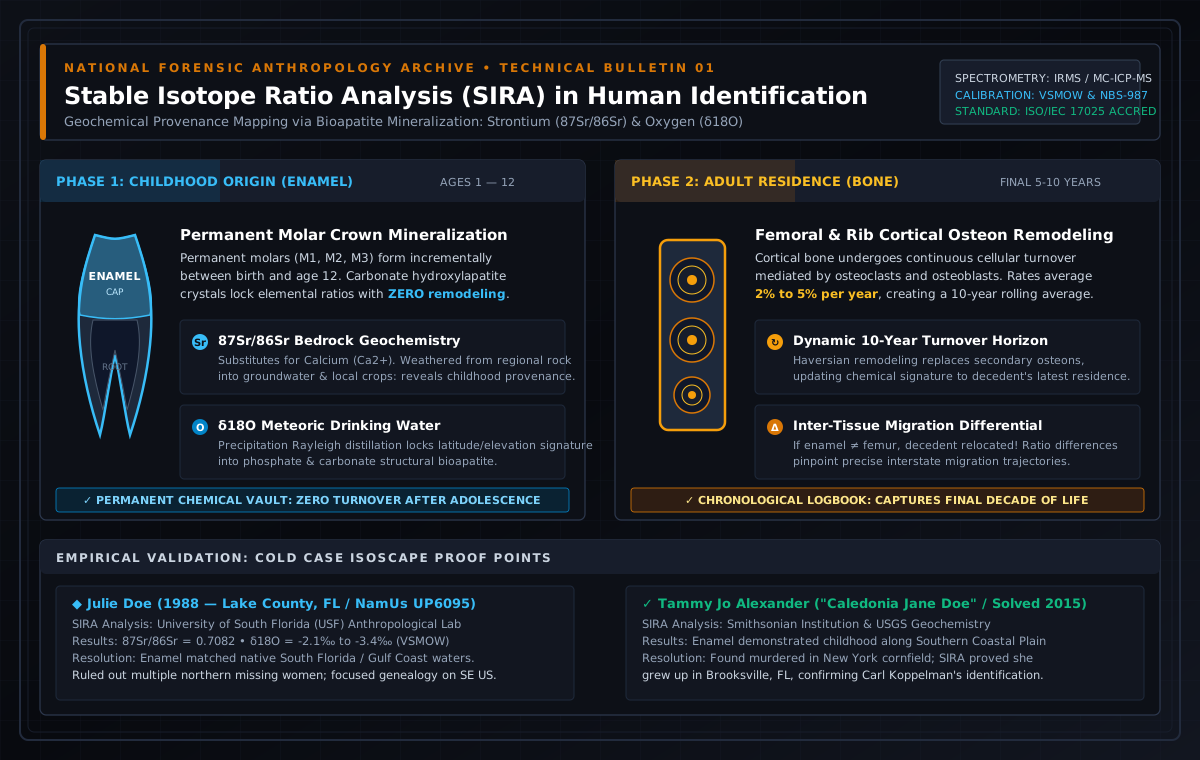
| Anatomical Substrate | Mineralization / Growth Window | Biological Turnover Rate | Forensic Time Horizon Captured |
|---|---|---|---|
| First Permanent Molar (M1) | Birth to ~3.5 years of age | Zero (Enamel does not remodel) | Permanent geochemical snapshot of infant/early childhood origin. |
| Third Molar ("Wisdom Tooth" M3) | Ages 9 to 14 years | Zero (Enamel does not remodel) | Permanent geochemical record of late childhood and early adolescence. |
| Cortical Femoral Bone | Adulthood (Secondary osteon remodeling) | ~2% to 5% per year | Integrated isotopic average of the decedent's last 5 to 10 years of life. |
| Trabecular (Spongy) Bone | Adulthood (Vertebrae, iliac crest) | ~10% to 25% per year | Reflects environmental residence during the final 12 to 36 months of life. |
| Hair Strands & Fingernails | Continuous (~1 cm per month for hair) | Zero after keratinization | Sequential week-by-week and month-by-month travel log prior to death. |
Unlike bone, tooth enamel contains no living osteoclasts or osteoblasts. Once crown mineralization completes during childhood, tooth enamel is chemically inert and does not remodel. If an adult victim is discovered in upstate New York, analyzing the enamel of their first molar can conclusively prove whether they were raised in the American Southwest, the Gulf Coast, or Eastern Europe.
Comparing the first molar (early childhood), third molar (adolescence), and cortical femur (adult life) creates a lifelong migratory trajectory, allowing anthropologists to pinpoint exactly when a decedent relocated across geographical regions.
Laboratory Micro-Sampling & Mass Spectrometry Protocols
Executing reliable isotope ratio analysis on decades-old skeletal remains requires rigorous laboratory countermeasures against postmortem diagenesis—the chemical contamination of bone minerals by groundwater, soil minerals, and microbial action during burial:
- Stereomicroscopic Precision Drilling: Analysts use diamond-tipped micro-drills under 40× stereomicroscopy to harvest pure enamel powder from interior enamel prisms, scrupulously avoiding the outer surface contaminated by oral bacteria and soil contact.
- Chemical Leaching & Diagenetic Stripping: Enamel and bone powders undergo sequential washings with dilute acetic acid (0.1 M CH3COOH) to selectively dissolve highly soluble secondary diagenetic calcite and soil carbonates, leaving only pristine biogenic hydroxyapatite intact.
- High-Resolution Mass Spectrometry:
- Thermal Ionization Mass Spectrometry (TIMS) & Multi-Collector ICP-MS: Employed for heavy strontium (87Sr/86Sr) and lead ratios, delivering precision down to the fifth decimal place.
- Continuous-Flow Isotope Ratio Mass Spectrometry (CF-IRMS): Couples an automated high-temperature elemental analyzer or GasBench to an IRMS for gas-phase analysis of δ18O, δ13C, and δ15N.
Landmark Cold Case Case Studies
Case Study 1: "Julie Doe" (Lake County, Florida • 1988)
In 1988, the skeletal remains of an unidentified transgender homicide victim were discovered in the Green Swamp of Lake County, Florida. For over two decades, investigators assumed the victim was a local Florida native.
In 2015, Dr. Erin Kimmerle and the forensic anthropology team at the University of South Florida (USF) conducted multi-isotope testing on her teeth and bones. The analysis revealed a striking geochemical divergence: her early-forming teeth exhibited low 87Sr/86Sr ratios (~0.708) and heavy δ18O values consistent with childhood residence in South Florida or the southern Gulf Coast. However, her cortical femoral bone showed an elevated strontium ratio (>0.712) and depleted oxygen values matching the southern Appalachian mountain corridor (western North Carolina or eastern Tennessee). This isotopic trajectory proved that she had relocated north during late adolescence before returning south to Florida shortly before her death, dramatically refocusing missing persons queries.
Case Study 2: Tammy Jo Alexander ("Caledonia Jane Doe" • 1979)
When the body of an unidentified teenage girl was discovered shot in a Livingston County, New York cornfield in November 1979, authorities had no indication of where she had originated. Thirty-five years later, Dr. Lesley Chesson and isotopic researchers tested her dental enamel and bone bioapatite. The oxygen and strontium isoscapes excluded the northeastern United States entirely, pointing unequivocally to the arid American Southwest (Arizona, Southern California) or the Gulf Coast.
This isotopic map provided critical validation when a childhood friend identified Carl Koppelman's forensic sketch as Tammy Jo Alexander of Brooksville, Florida, who had run away to the Southwest before vanishing.
Limitations & Future Integration with Genetic Genealogy
Stable isotope ratio analysis does not yield a Social Security number or a family surname; rather, it produces probabilistic geographic envelopes. Modern municipal water treatment, long-distance importation of bottled water, and globalized commercial grocery supply chains can partially buffer local dietary signals in contemporary populations.
The cutting edge of forensic death investigation pairs SIRA with Investigative Genetic Genealogy (IGG). When genetic genealogists encounter a sprawling family tree spanning eight states, isotopic profiling functions as an indispensable geographic filter—allowing investigators to instantly narrow 200 possible genealogical cousins down to the single branch that grew up in the specific watershed delineated by the decedent's tooth enamel.