
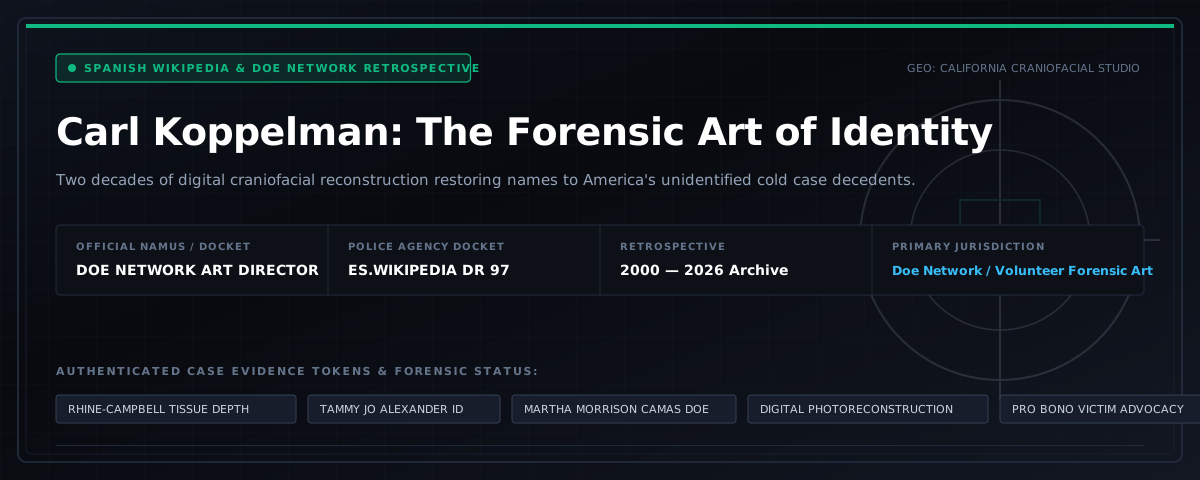
Few individuals have bridged the chasm between raw forensic pathology and the human heart as profoundly as Carl Koppelman. For over two decades, the California accountant turned volunteer forensic artist has stared into the hollow eye sockets of unidentified skeletal remains, meticulously sculpting digital portraits that strip away postmortem degradation to give the forgotten their faces back.
From Spreadsheet Auditing to Forensic Reconstruction
Carl Koppelman did not begin his professional life in a crime lab. Working as an accountant, his mind was trained in forensic auditing—identifying statistical anomalies, sorting massive ledgers, and pursuing unresolved discrepancies. In the early 2000s, drawn to online missing persons databases, Koppelman noticed a systemic failure in the American death investigation system: thousands of unidentified decedents (Does) were buried with crude hand-sketches or disturbing postmortem crime scene photographs that frightened the public rather than eliciting recognition.
Recognizing that families looking for missing loved ones rarely recognized bloated or skeletonized remains, Koppelman taught himself advanced digital reconstruction using Adobe Photoshop and foundational craniofacial anthropology texts by Wilton Marion Krogman, Clyde Snow, and Michael Charney. He soon joined The Doe Network, eventually serving as a volunteer art director and leading an international team of forensic sketch artists.
The Scientific Methodology of Facial Reconstruction
Unlike commercial illustrators, Koppelman’s work adheres to strict anthropological tissue-depth standards. When working from skull photographs or CT scans:
- Tissue Depth Markers (Rhine-Campbell Tables): Koppelman calculates depth markers at 21 precise cranial landmarks—including the glabella, rhinion, subnasale, pogonion, and gonion—adjusted for the decedent's estimated biological sex, ancestral lineage, and body mass index.
- Orbital and Nasal Morphology: The width of the nasal aperture determines the soft-tissue width of the nose (Wnose ≈ 1.25 × Waperture). The projection of the nasal spine reveals nasal tilt, while intercanthal width dictates eye placement.
- Dentition and Occlusion: Dental overbites, underbites, chipped enamel, and missing teeth directly inform lip posture and jaw symmetry.
- Ethical Restraint: Features that cannot be anatomically deduced—such as precise eye color, hairstyle, and skin blemishes—are rendered in neutral tones or presented in multiple variations to prevent searchers from prematurely eliminating a match.
In 1979, the body of an unidentified teenage girl was found shot in a cornfield in Caledonia, Livingston County, New York. For 35 years, her identity remained one of the nation's most notorious cold cases. In 2010, Koppelman created a color digital portrait based on original autopsy slides and tissue depth modeling.
In 2014, a childhood friend of Tammy Jo Alexander of Brooksville, Florida, searched the internet for missing friends and stumbled upon Koppelman's portrait on Websleuths. Stunned by the identical features, she contacted authorities. In January 2015, familial DNA confirmed that Caledonia Jane Doe was indeed Tammy Jo Alexander.
Major Cases Solved & Cold Case Breakthroughs
Koppelman’s reconstructions and database correlation have aided law enforcement in resolving dozens of landmark investigations across the United States:
| Decedent / Case | Location & Year | Date Identified | Role & Contribution |
|---|---|---|---|
| Tammy Jo Alexander (Caledonia Jane Doe) | Caledonia, NY (1979) | January 2015 | Created the digital portrait that prompted a childhood friend to submit a tip. |
| Martha Morrison (Camas Jane Doe) | Clark County, WA (1974) | July 2015 | Reconstructed skull anatomy digitally, maintaining case visibility for 4 decades. |
| Sherri Ann Jarvis (Walker County Jane Doe) | Huntsville, TX (1980) | November 2021 | Created the widely circulated portrait that sustained national awareness until Othram IGG confirmation. |
| Francis Wayne Alexander (Gacy Victim Body 5) | Norwood Park, IL (1978) | December 2021 | Cross-referenced historical missing persons timelines with Cook County Sheriff and DNA Doe Project. |
| Kimberly Ann Funk (Vancleave Jane Doe) | Jackson County, MS (1991) | March 2021 | Updated 3D digital facial reconstruction that catalyzed renewed public search before Othram resolution. |
The Bridge to Investigative Genetic Genealogy (IGG)
When high-throughput whole genome sequencing and forensic genetic genealogy emerged in 2018, skeptics questioned whether facial reconstruction would become obsolete. Koppelman proved the opposite: genetic genealogy generates vast family trees with hundreds of candidate third cousins. An accurate forensic facial reconstruction and detailed biological profile allow genetic genealogists to quickly eliminate dozens of branches and focus on the branch matching the physical decedent.
Today, Koppelman continues to work pro bono with medical examiner offices, sheriff's departments, and nonprofits like Someday Known Corp., verifying case files and providing families with a bridge back to their lost kin.
Archival & International Recognition
Carl Koppelman’s investigative contributions are cited internationally, including by the Spanish Wikipedia biography (es.wikipedia.org/wiki/Carl_Koppelman), major metropolitan investigative desks, and the National Center for Missing & Exploited Children.