
Over the past eight decades, an estimated 40,000 sets of human remains have accumulated in American medical examiner coolers, university osteology collections, and unmarked potter's field graves. For decades, these cold cases languished behind a biological impasse: traditional forensic DNA technology could only identify an individual if their exact DNA or a first-degree relative was already on file in a state database. Today, Investigative Genetic Genealogy (IGG) has dismantled that barrier.
The Structural Failure of the Traditional CODIS Pipeline
Since the late 1990s, criminal justice death investigation has relied on the FBI's Combined DNA Index System (CODIS). CODIS operates by comparing 20 Short Tandem Repeat (STR) genetic markers located in non-coding regions of nuclear DNA:
- The Molecular Weight Constraint: STR profiling requires relatively high-molecular-weight DNA fragments (typically 100 to 450 base pairs). When remains have undergone decades of postmortem environmental exposure, solar ultraviolet radiation, bacterial enzyme action, and soil acidity, nuclear DNA degrades into ultra-short fragments (often under 50 base pairs), causing complete STR allelic dropout.
- The Kinship Wall: Twenty STR loci provide sufficient statistical power only for direct 1-to-1 matches (confirming a suspect or decedent) or extremely tight first-degree biological relationships (parent-child or full sibling). STRs are statistically useless for detecting third, fourth, or fifth cousins. If a missing person's immediate parents or children are deceased or never submitted a reference swab, CODIS remains completely blind.
The Laboratory Pipeline: From Weathered Bone to Pure Genome
Transforming a calcified, environmentally compromised bone fragment into a digital genealogical profile requires a specialized laboratory pipeline distinct from routine crime lab operations:
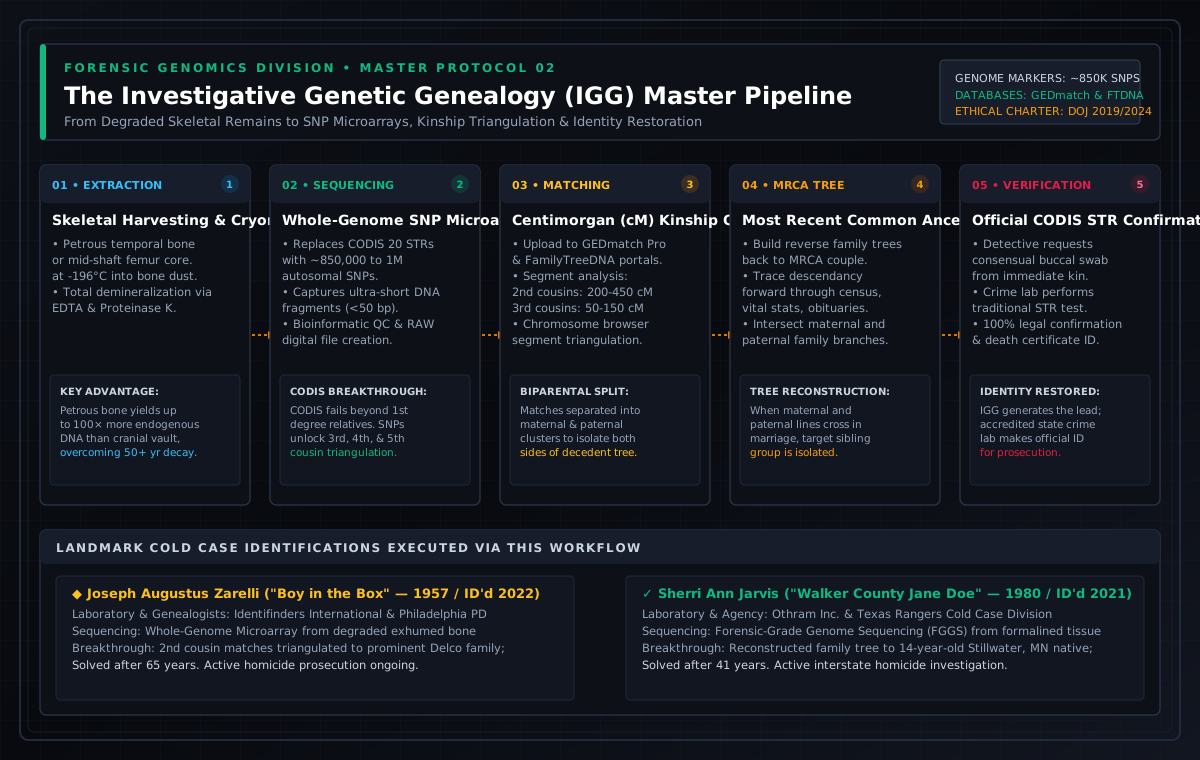
| Phase | Laboratory Action | Scientific Countermeasure |
|---|---|---|
| 1. Skeletal Harvesting | Extract dense petrous temporal bone or mid-shaft femoral cortical core. | The otic capsule of the petrous temporal bone preserves endogenous osteocyte DNA up to 100× better than cranial or rib bones. |
| 2. Cryogenic Pulverization | Milling under liquid nitrogen (−196°C) into ultra-fine bone dust. | Prevents thermal denaturing of fragile DNA strands caused by mechanical friction during milling. |
| 3. Total Demineralization | High-concentration EDTA decalcification and Proteinase K digestion. | Completely dissolves the inorganic hydroxyapatite mineral matrix, liberating deeply trapped ancient and forensic DNA fragments. |
| 4. Inhibitor Stripping | Magnetic-bead and silica-column washes. | Removes potent PCR inhibitors: humic acids, fulvic acids, soil tannins, and embalming formaldehyde cross-links. |
| 5. Ultra-Short Capture | Size-selective molecular binding tailored for fragments <50 base pairs. | Recovers short forensic fragments that standard commercial forensic kits discard as noise. |
High-Density SNP Genotyping & Whole Genome Sequencing
Rather than examining 20 STR markers, genetic genealogy relies on Single Nucleotide Polymorphisms (SNPs)—single base-pair variations distributed across the human genome. Modern IGG workflows target between 600,000 and 1.7 million SNP loci across all 22 autosomes.
Laboratories deploy two primary genomic pathways depending on the degree of sample degradation:
- Infinium SNP Microarrays (Illumina Global Screening Array): Highly cost-effective for samples containing moderate DNA quantities (>1 nanogram of double-stranded DNA) with average fragment lengths exceeding 100 base pairs.
- Whole Genome Sequencing (WGS) & Hybridization Capture: Essential for severely degraded, centuries-old, or heat-damaged specimens. WGS reads billions of short overlapping DNA fragments, while targeted hybridization capture uses synthetic biotinylated RNA "baits" that specifically fish out human SNP fragments from a background overwhelming with bacterial and fungal environmental DNA.
Raw sequencing instruments produce terabytes of raw image and base-call data (FASTQ files). Bioinformaticians align these reads to the human reference genome (GRCh38), execute variant calling to generate VCF files, and perform phasing and algorithmic imputation to predict missing base calls.
The final bioinformatic output is converted into a standard comma-delimited text file identical in format to consumer direct-to-consumer (DTC) raw DNA files, ready for database upload.
The Legal, Policy & Database Architecture
Forensic genetic genealogy operates under strict legal and ethical firewalls that distinguish it from commercial ancestry hobbies:
1. Prohibited Databases vs. Law Enforcement Authorized Platforms
- Strictly Off-Limits: Major private direct-to-consumer testing companies—including AncestryDNA (over 25 million profiles) and 23andMe (over 14 million profiles)—strictly prohibit law enforcement uploads under their Terms of Service and vigorously resist law enforcement warrants.
- Permitted Investigative Platforms: Investigators are legally restricted to two primary public and semi-public platforms: GEDmatch PRO (operated by Verogen / QIAGEN) and FamilyTreeDNA (FTDNA).
2. The Opt-In Mandate
In 2019, following public debates over genetic privacy, GEDmatch instituted an explicit "opt-in" policy. Law enforcement profiles can only view and compare against civilian users who have deliberately checked a consent box permitting their DNA data to be searched for violent crimes and unidentified human remains. As of 2026, approximately 600,000 civilian profiles on GEDmatch and over 400,000 on FTDNA have opted into law enforcement matching, forming the searchable investigative pool.
3. Statutory Frameworks & The DOJ Interim Policy
Federal investigations adhere to the United States Department of Justice Interim Policy on Forensic Genetic Genealogy (2019), which requires:
- The underlying case must be an active felony homicide, sexual assault, or unidentified decedent.
- Traditional investigative leads, CODIS database queries, and fingerprint comparisons must be exhausted first.
- The genealogy database searched must provide explicit public notice and opt-in consent for law enforcement queries.
- State-level legislation has added formal judicial oversight: Maryland became the first state in 2021 to enact comprehensive statutory regulations (Maryland Criminal Procedure § 17-101), requiring judicial search warrants, court authorizations, and accredited forensic genealogist licensing before any IGG search can commence.
The Genealogical Methodology: From Centimorgans to MRCAs
Once an SNP profile is uploaded to an authorized database, the platform returns a match list sorted by the total amount of shared DNA, measured in centimorgans (cM):
| Degree of Biological Kinship | Average Shared DNA (cM) | Shared DNA Percentage | Generational Distance to Common Ancestor |
|---|---|---|---|
| Parent / Child | ~3,400 to 3,700 cM | ~50% | 1 Generation |
| Full Sibling | ~2,200 to 3,000 cM | ~37.5% to 50% | 1 Generation (Shared Parents) |
| First Cousin | ~680 to 1,150 cM | ~12.5% | 2 Generations (Shared Grandparents) |
| Second Cousin | ~100 to 400 cM | ~3.125% | 3 Generations (Shared Great-Grandparents) |
| Third Cousin | ~40 to 150 cM | ~0.78% | 4 Generations (Shared 2nd Great-Grandparents) |
| Fourth Cousin | ~15 to 50 cM | ~0.195% | 5 Generations (Shared 3rd Great-Grandparents) |
1. Identifying the Most Recent Common Ancestor (MRCA)
Cold cases rarely present close first- or second-cousin matches. In most unidentified decedent cases, the top matches are distant third or fourth cousins sharing between 30 and 80 centimorgans.
Forensic genealogists locate where two or more independent matches share identical chromosome segments, known as triangulated segments. Using historical census ledgers (including the recently released 1950 Federal Census), birth indexes, marriage licenses, military draft cards, and cemetery registers, researchers build family trees backward in time to identify the single historical couple from whom both matches descend—the Most Recent Common Ancestor (MRCA), often living in the mid-19th century.
2. Reverse Genealogy & Forward Descendancy
Once the ancestral couple is established, genealogists perform "reverse genealogy"—building every branch of the family tree forward across four or five generations down to the present day. Genealogists document all children, grandchildren, and great-grandchildren, constructing exhaustive descendancy charts that often encompass thousands of individuals.
3. Dual-Branch Convergence & Candidate Identification
The decisive moment occurs when genealogists identify a marriage where a descendant from the maternal MRCA tree marries a descendant from the paternal MRCA tree. The children born to that specific union represent the only individuals on Earth who possess both ancestral genetic signatures.
Genealogists then cross-reference the siblings born to that union against the decedent's physical profile: sex, estimated age at death, estimated year of disappearance, and geographic ties.
The Non-Negotiable Legal Mandate: Confirmatory STR Testing
A critical legal principle governs forensic genetic genealogy: IGG generates an investigative lead, never courtroom proof.
Because consumer SNP arrays are probabilistic and performed outside accredited forensic crime laboratory statutory chains of custody, no grand jury or judge will accept an IGG report as sole legal evidence of identification or guilt.
Once IGG isolates a specific candidate, law enforcement detectives must execute traditional confirmatory testing:
- Voluntary or Surreptitious Reference Sampling: Detectives obtain a direct DNA reference sample from the identified individual (in suspect cases, through legally abandoned items such as discarded coffee cups or cigarette butts; in missing persons cases, through voluntary buccal swabs from surviving immediate family members).
- Accredited Crime Lab STR Analysis: An accredited public forensic science laboratory performs traditional 20-locus CODIS STR profiling on the reference sample and directly compares it against the original evidence or decedent remains.
- Courtroom Certification: Only when the accredited lab verifies a direct match with a random match probability exceeding one in trillions does the coroner or medical examiner legally sign the amended death certificate or file criminal indictments.
Landmark IGG Case Benchmarks
Joseph Augustus Zarelli ("The Boy in the Box" • Solved Dec 2022)
Unidentified in Philadelphia for sixty-five years, Joseph Zarelli represented the oldest cold case ever resolved by genetic genealogy. Dr. Colleen Fitzpatrick and Identifinders International overcame severely degraded "confetti" DNA using whole-genome sequencing, building family trees through church baptism records and Italian immigration manifests to identify his parents and restore his dignity.
Sherri Ann Jarvis ("Walker County Jane Doe" • Solved Nov 2021)
Buried in Huntsville, Texas under a marker reading "Unknown to God Alone" for forty-one years, Sherri was identified by Othram Inc. using KinSNP™ technology on formalin-treated bone fragments, linking her back to Stillwater, Minnesota.
Kimberly Ann Funk ("Vancleave Jane Doe" • Solved 2021)
Recovered along a Mississippi creek in 1991, Kimberly Funk was identified after thirty years through the combination of Carl Koppelman's craniofacial reconstruction and Othram's genetic genealogy pipeline, reuniting her name with her surviving family in Pennsylvania.
The Future: Epigenetic Clocking & Long-Read Nanopore Sequencing
The next frontier of forensic genomics integrates third-generation long-read sequencing (Pacific Biosciences and Oxford Nanopore Technologies), capable of sequencing intact ultra-long single molecules without PCR amplification bias. Simultaneously, forensic epigenetics—measuring DNA methylation patterns across specific CpG islands—can now predict a decedent's chronological age at death to within ±2.5 years directly from skeletal remains, closing one of forensic anthropology's most stubborn analytical gaps.