
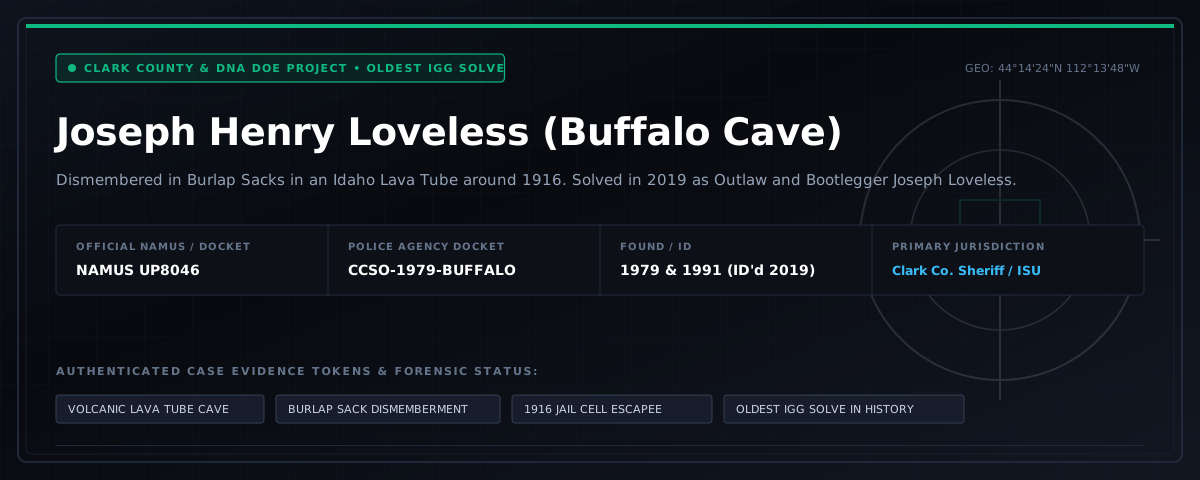
Solved via IGG NAMUS: UP8046 (SOLVED) • DOE NETWORK: 1421UMID • AGENCY CASE: CCSO-1979-BUFFALO • JURISDICTION: Clark County Sheriff's Office & Idaho State University

Joseph Henry Loveless: Buffalo Cave Torso Solved via IGG

Dismembered in an Idaho lava tube in 1916: How the DNA Doe Project made forensic history by identifying outlaw Joseph Henry Loveless.

Archival Case File Banner: Joseph Henry Loveless (Buffalo Cave Torso)
SECTION 1: THE OFFICIAL CASE RECORD (VERIFIED FACTS)
Official Case Date 1979 & 1991 (Identified Dec 2019)
Discovery / Last Seen Location Buffalo Cave Lava Tubes, Dubois, Clark County, ID
Demographic Profile White Male, 46 Years Old (Outlaw / Bootlegger)
Anthropological Age Estimate 46 Years Old (DOB: Dec 3, 1870, Died ~1916)
Primary Investigating Agency Clark County Sheriff / ISU / DNA Doe Project
Forensic Identifiers Available Burlap Sacks, Dismembered by Axe/Saw, 1916 St. Anthony Jail Escapee

The 1979 & 1991 Buffalo Cave Discoveries

In 1979, family members hunting for arrowheads and civil war relics inside Buffalo Cave—a remote volcanic lava tube located near Dubois in Clark County, Idaho—discovered human remains wrapped in a decaying burlap sack stuffed inside an alcove. The remains consisted solely of a headless, limbless human torso.

Twelve years later, in 1991, an 11-year-old girl exploring the same cave system discovered a partially mummified human hand and arm protruding from a rock crevice. Clark County Sheriff's deputies and anthropologists excavated the area, discovering two legs and the matching arm wrapped in burlap sacks and decaying burlap cloth. The skull was never found.

Anthropological Examination & The Century-Old Mystery

Forensic anthropologists from Idaho State University, led by Dr. Samantha Blatt, and the Smithsonian Institution examined the remains. The decedent was a White male of European descent, standing approximately 5 feet 11 inches tall, with reddish-brown hair flecked with gray.

Skeletal analysis revealed that the decedent had been dismembered with an axe, saw, and heavy butcher's knife shortly after death. The clothing consisted of a dark wool suit coat, white collared shirt, and denim overalls. While investigators initially believed the body was a 20th-century homicide, radiocarbon dating and garment construction placed the death around 1916. He was cataloged in NamUs as UP8046.

The Oldest Forensic Genealogy Solve in History

In 2019, the Clark County Sheriff's Office partnered with Anthony Redgrave, Lee Bingham Redgrave, and the DNA Doe Project to attempt genetic genealogy on century-old bone fragments. Despite extreme taphonomic degradation, modern extraction protocols yielded a functional SNP profile.

Genealogists traced candidate trees back through 19th-century pioneer lines in Utah and Idaho. In December 2019, authorities announced that Buffalo Cave John Doe was Joseph Henry Loveless, an outlaw, bootlegger, and counterfeit artist born in Payson, Utah Territory, on December 3, 1870. The case established a world record as the oldest unidentified forensic homicide victim ever resolved via investigative genetic genealogy.

SECTION 2: PROMINENT COMMUNITY THEORIES & ANALYTICAL HYPOTHESES
Investigative Ethics & E-E-A-T Guarantee: This analytical section examines documented community theories, crowdsourced timeline comparisons from verified cold-case forums (Websleuths, Reddit r/UnresolvedMysteries, Doe Network), and geographic distribution models. In strict accordance with our nonprofit charter, no living unindicted private citizens are named or accused. All hypotheses evaluate physical markers, transportation corridors, and anatomical evidence.

Forensic Taphonomy of Volcanic Lava Caves

The preservation of Joseph Henry Loveless's soft tissue and clothing over more than a century is attributable to the unique microclimatic taphonomy of eastern Idaho's basaltic lava tubes. Buffalo Cave maintains constant subterranean temperatures (near 40°F / 4°C) with dry atmospheric conditions and protection from solar ultraviolet degradation.

These environmental conditions facilitated natural mummification rather than typical skeletonization, preserving hair, skin pigments, and textile fibers. Without the stability of the lava tube environment, extracting usable nuclear DNA from nineteenth-century bone elements would have been virtually impossible.

SECTION 3: LAW ENFORCEMENT SUBMISSION & OFFICIAL TIP LINE

Have Information Concerning This Investigation?

Even the smallest detail—a recollection of a vehicle, a seasonal acquaintance, or an old photograph—can provide the missing link to solving a multi-decade cold case. All leads submitted through official channels are cross-referenced with state databases and active forensic profiles.

Clark County Sheriff's Office (Idaho)
(208) 374-5403
Call Detective
Idaho State University Department of Anthropology
(208) 282-2629
Call Agency
FBI ViCAP (Violent Criminal Apprehension)
1-800-CALL-FBI
OFFICIAL CASE CODES: NamUs: UP8046 (SOLVED) • Case Docket: CCSO-1979-BUFFALO. Reference these identifiers when submitting information.
Submit Anonymous Case Tip