
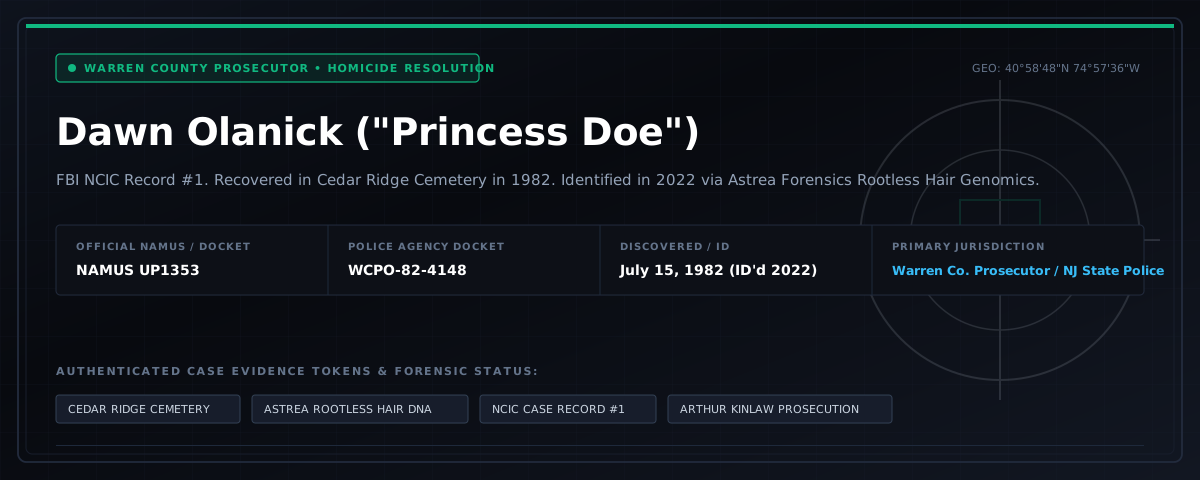
On the morning of Thursday, July 15, 1982, gravediggers at the Cedar Ridge Cemetery in Blairstown, New Jersey, discovered the brutally beaten body of an unidentified teenage girl lying face-down in a ravine bordering the cemetery. For forty years, she was known only as "Princess Doe"—the very first unidentified decedent record ever entered into the FBI's National Crime Information Center (NCIC).
The Discovery & Crime Scene
The victim was found fully dressed in a red short-sleeve shirt with yellow piping and a wrap-around red-and-white patterned skirt, but she wore no shoes or jewelry. Forensic examination revealed catastrophic blunt force trauma to the head and face, inflicted with a heavy bladed or blunt instrument that fractured her facial skeleton and severed her jaw. Pathologists estimated she had been killed less than 72 hours prior to discovery.
Because she possessed no identification, Blairstown Police Chief James Monegan and Warren County detectives launched an unprecedented regional campaign. When local funds for her burial ran out, the townspeople of Blairstown rallied to purchase a burial plot in the same cemetery where she was found. A granite headstone was erected reading: "Princess Doe. Missing from someone, someone may care. Rest in peace in the hands of God."
Chronological Case Timeline
| Date / Year | Location | Investigative Milestone |
|---|---|---|
| July 15, 1982 | Blairstown, NJ | Deceased female discovered in ravine at Cedar Ridge Cemetery. Estimated age: 14–18. |
| June 30, 1983 | Washington, D.C. | FBI Director William H. Webster enters Princess Doe as Record #1 in the new NCIC Unidentified Persons file. |
| Jan 22, 1983 | Blairstown, NJ | Community holds solemn memorial and buries decedent at Cedar Ridge Cemetery. |
| 1999 & 2012 | Warren County, NJ | Remains exhumed for modern mitochondrial and STR DNA extraction; profile entered into CODIS. |
| 2021 | Santa Cruz, CA | Warren Co. Prosecutor partners with Astrea Forensics; rootless hair yields actionable whole-genome SNPs. |
| July 15, 2022 | Belvidere, NJ | On the exact 40th anniversary of her discovery, authorities announce she is Dawn Olanick; Arthur Kinlaw charged with murder. |
The Astrea Forensics Rootless Hair Breakthrough
Traditional forensic DNA extraction relies on blood, tissue, or the nutrient-rich root bulb of a hair shaft. Shed, rootless hair shafts were historically considered useless for nuclear DNA testing because hair keratinization shears chromosomal DNA into microscopic fragments under 50 base pairs long.
In 2021, Warren County investigators submitted preserved rootless hairs from the 1982 autopsy to Astrea Forensics, a specialized paleogenomics laboratory founded by University of California Santa Cruz researchers. Astrea utilized ancient-DNA extraction chemistry originally developed for Neanderthal fossils, capturing sub-50-bp fragment libraries to construct a comprehensive single nucleotide polymorphism (SNP) profile.
Genealogist Eric Schubert analyzed the resulting raw genetic data, triangulating distant cousin matches across New York and New Jersey to a family rooted in Bohemia, Long Island. In early 2022, detectives collected consensual reference DNA from Dawn's biological mother and sister, achieving a 100% legal confirmation. Dawn Olanick had vanished in early summer 1982 at age 17 after leaving home.